

Review: Magellan (2025)
[The following review contains MINOR SPOILERS; YOU HAVE BEEN WARNED!]

Quite early on in director Lav Diaz’s Magellan, the governor of a newly conquered territory outlines the Portuguese crown’s imperialist ambitions. Their mission, he explains to the assembled soldiers, is threefold: to spread Christianity at the point of a sword, to extinguish the influence of “heretical” religions, and—perhaps most importantly—to seize control of global trade routes, thus toppling rival nations via starvation. (Sounds familiar, doesn’t it?) The fact that he passes out in a drunken stupor mid-sentence does little to discourage his subordinates; while they mock their leader’s foolishness (indeed, they leave him lying exactly where he fell for hours), they remain steadfastly committed to his dubious “ideals.”
This scene elegantly encapsulates the film’s central thesis. This is neither a typical biopic nor a conventional historical drama; beyond the superficialities of genre, it is, first and foremost, a deconstruction of the myth of the “noble explorer.” You’ve probably encountered the archetype in a few dozen elementary school textbooks: the intrepid adventurer, heroically bringing “civilization” to “savage” lands (see: Marco Polo, Christopher Columbus, Hernán Cortés). Diaz dispenses with these romanticized illusions altogether: he depicts colonialism as inherently bloody work, immoral and unjustifiable.

The character of Enrique—a slave that accompanies the protagonist on his expeditions—vividly personifies the consequences of such violent “progress.” During his introduction, he desperately prays to a deity worshipped by his ancestors: “Stop hiding, you stupid sun god,” he cries, defying the torrential rain pelting him through the bars of his cage. Despite faithfully adhering to the customs and rituals of his birthplace, however, he later tearfully admits that he remembers precious little else about his home—he's even forgotten the faces of his family. In haunting detail, he describes the dehumanizing process of being acquired by a series of owners—Indian, Chinese, Arab—before finally ending up in Captain Ferdinand’s possession. Deprived of his identity and reduced to another man's property, he reluctantly serves as an accomplice to his master’s acts of cultural genocide, facilitating the native populace’s assimilation in his capacity as a translator. He witnesses the desecration of “pagan” idols and the punishment of “apostates,” his personal anguish projected across an entire tribe—a brutal system of oppression and subjugation.
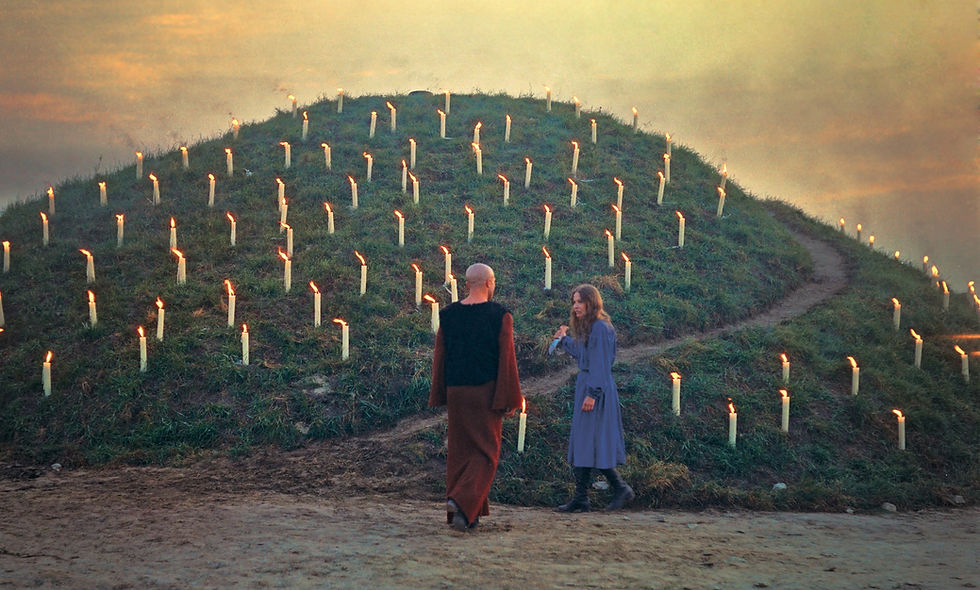
The result of this conflict is, of course, a beach littered with corpses, sand and surf alike stained red. Diaz emphasizes the senselessness of the slaughter by adopting a minimalistic visual style, utterly devoid of spectacle: his camera observes the carnage from a detached distance, static and unflinching, confronting viewers with the cruelty upon which “modern society” was built—the spiritual pollution of which still lingers to this day.


Comments