

Review: Backrooms
[The following review contains MINOR SPOILERS; YOU HAVE BEEN WARNED!]
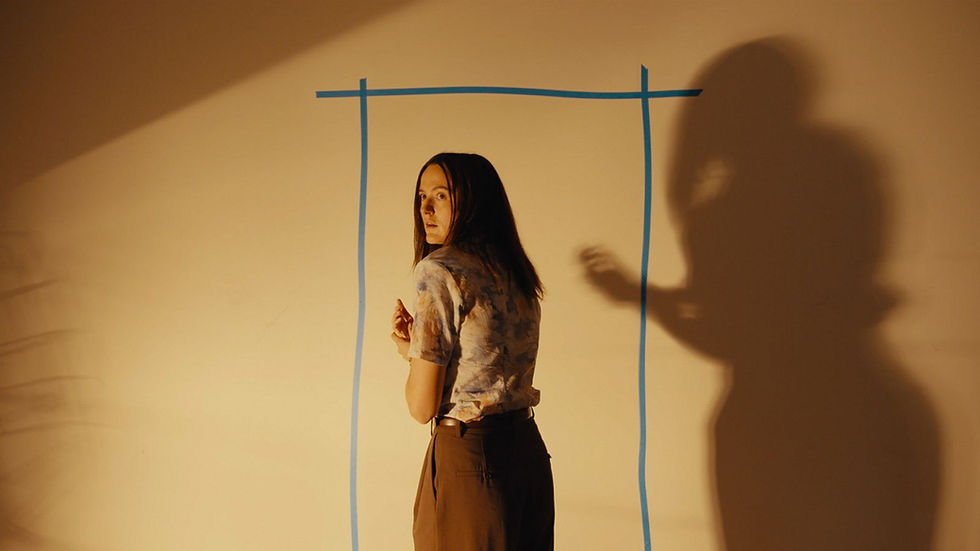
Backrooms is one of those movies that lingers in your subconscious long after the end credits have rolled. My initial reaction to Kane Parsons' vision of “liminal horror” was, to be perfectly honest, rather lukewarm; while the direction was quite competent by the usual standards of a feature debut—moody, evocative, stylish—the plot frequently felt haphazardly structured and thinly sketched (particularly in the second half). Once I’d digested the story’s subtleties and subtext, however, certain details that I’d previously overlooked emerged, transcending the surrounding blemishes and elevating the entire experience.
Consider, for example, the revelation early in Act 1 that Chiwetel Ejiofor’s Clark (a recent divorcé that often retreats into his work to avoid confronting his rarely glimpsed wife, who he transparently resents) has literally taken up residence in the furniture showroom that he manages, inhabiting uncannily empty imitations of the idealized, cookie cutter domestic spaces that he abandoned.

Consider, too, the fact that both Clark and his therapist, Renate Reinsve’s Mary Kline, appear in televised commercials advertising their respective businesses, presenting distorted, almost abstracted facsimiles of their personae to the general public.
And on the subject of Mary, consider the occasional flashbacks to her past: brief, fragmented glimpses of neglect, abuse, and misfortune that overlap, intertwine, and converge until concrete memories of unresolved grief and childhood trauma erode and flatten into vague symbols of thereof, one tragedy indistinguishable from the next—a blurred and faded copy of a copy of a copy, reflected in a series of funhouse mirrors ad infinitum.

Beyond their immediate narrative function of foreshadowing the supernatural conflict that gradually develops, these recurring visual motifs—haunting in their mundanity—serve a profound thematic purpose (which becomes increasingly obvious with the benefit of hindsight). But I won’t delve into an exhaustive critical analysis here—because I believe that definitive “solutions” to the film’s mysteries are antithetical to Parsons’ true intent. Much like the eponymous limbo dimension, the aforementioned imagery is a sprawling, complex, labyrinthine blank slate onto which each viewer projects their own subjective interpretation (feminist, Marxist, et cetera)—and that ambiguity is precisely what makes Backrooms so stealthily unnerving: it is, at its core, a meditation on the futile search for deeper meaning amidst the inherent meaninglessness of modern life.
Good luck finding spiritual fulfillment when society is a decaying mall.



Comments