

Review: The Boston Strangler (1968)
[The following review contains MINOR SPOILERS; YOU HAVE BEEN WARNED!]

Richard Fleischer’s The Boston Strangler is a fascinating paradox. In some respects (e.g., in terms of its plot, narrative structure, and character archetypes), it’s a rather typical police procedural—albeit a remarkably lurid example of the genre by the standards of the late '60s (the degree of exploitative, voyeuristic sleaze in which it indulges is, in my experience, more commonly associated with the '70s—though there are, of course, exceptions to this generalization, such as 1965's unapologetically sensationalistic Who Killed Teddy Bear). It is also radically experimental for a Hollywood studio production, boasting an unconventional cinematic language that often borders on avant-garde. It is difficult to articulate the visceral impact of this almost subliminal dissonance between substance and style; I can only describe the imagery and hope that it speaks for itself.
The film opens with a shot of a television screen flickering in a featureless black void. Gradually, the surrounding environment fades into view: a modest apartment—cozy, tidy, and utterly nondescript. As the news anchor drones on, an unseen intruder—reduced to a pair of hands clad in black leather gloves—thoroughly ransacks this familiar domestic space, tearing open cabinets and closets, rummaging through drawers, ripping clothing and undergarments to shreds, shattering vases and bottles. Slowly, the camera pans, revealing the freshly slain corpse of the home’s occupant. It’s a haunting scene: an elderly woman lying dead on her own carpet while a stranger violates her privacy, exposing and defiling her most intimate possessions.
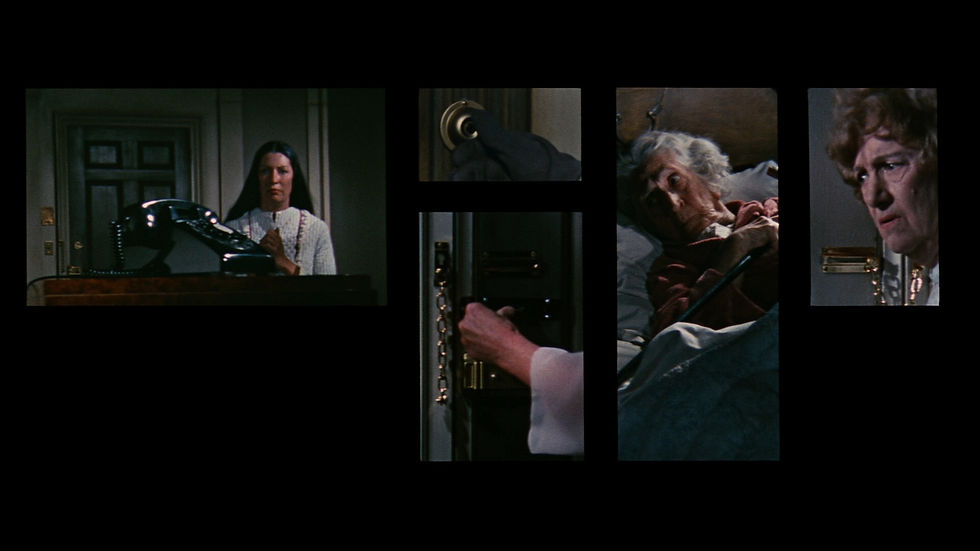
This prologue economically establishes the visual motifs and underlying themes that will recur throughout the story. The discovery of a subsequent murder, for instance, unfolds entirely via split screen. On the right: the cramped, bustling hallway of a tenement building; residents exchange pleasantries, gossip, gripe about the negligent landlord—it is, in summary, the quintessential average morning in urban America. To the left, however: an eerily dark bedroom; and in the foreground, so faintly illuminated that they are nearly indistinguishable from the adjacent furniture: a pair of human legs, stiff with rigor mortis. The geographical relationship between the parallel frames of this cinematic diptych is not immediately apparent—until a nosy neighbor opens the door, unifying the juxtaposed settings (mundane routine/fatal disruption) in spectacularly horrifying fashion. The specter of violence, we learn, is insidiously pervasive, lurking around every corner. It rarely announces its presence; on the contrary, it arrives abruptly, unexpectedly, and anonymously.
Although there is much that elevates The Boston Strangler—particularly the magnificent performances by Tony Curtis and Henry Fonda as the eponymous serial killer and lead investigator, respectively (providing a compelling study in contrasts between protagonist and antagonist: working class/college educated, psychologically repressed/intellectually curious, emotionally volatile/empathetic)—it is, first and foremost, simply a joy to look at. I cannot imagine higher praise for a movie.


Comments