

Review: Electra, My Love
[The following review contains MINOR SPOILERS; YOU HAVE BEEN WARNED!]
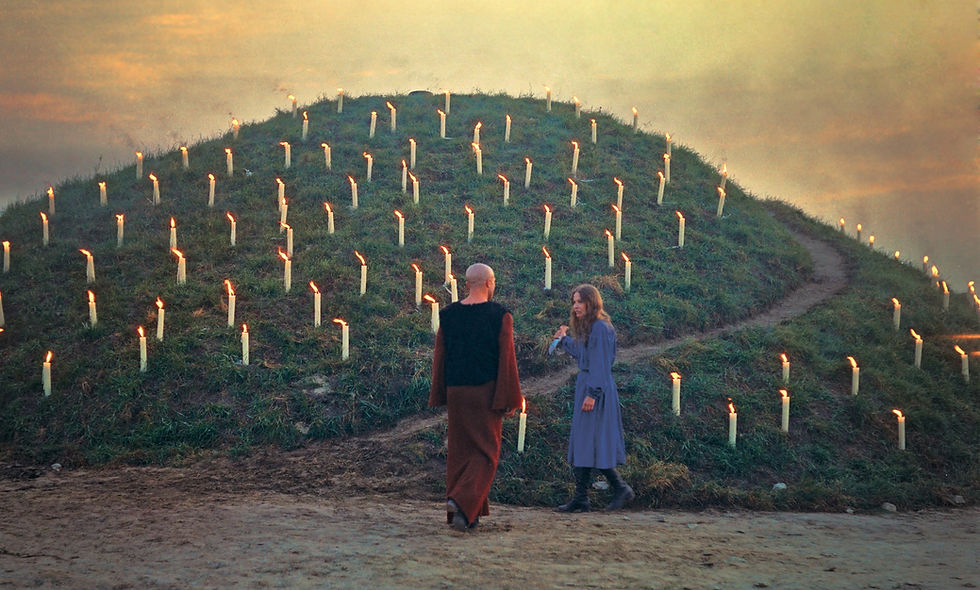
Those seeking a “traditional” adaptation of the most iconic episode in the Orestes saga (inspired, perhaps, by the short interlude revolving around Agamemnon and Clytemnestra in Nolan’s The Odyssey, as I certainly was) will probably find Electra, My Love rather disappointing. While the film borrows liberally from the versions of the Greek tragedy dramatized by Sophocles, Euripides, and Aeschylus, Hungarian director Miklós Jancsó’s interpretation of the classical source material is extremely unconventional. The fundamental elements of the original myth—loyalty, suffering, faith, vengeance, transgression, penitence—remain intact to one degree or another, but merely provide a narrative framework; the characters are reduced to archetypes, the themes distilled to metaphors in what is essentially a scathing antiauthoritarian manifesto.
Even this description, however, seems too literalist to adequately convey the movie’s surreal, hypnotic tone. The “plot” is borderline irrelevant; this is pure visual poetry, a cinematic allegory, a dreamy celluloid hallucination. Hundreds of extras navigate sprawling landscapes in elaborately choreographed dance sequences—a symbol of conformity and resignation to exploitation/subjugation. The thundering hoofbeats of galloping horses pervade the soundtrack, and soldiers march in perfect unison, cracking whips at regular intervals—the symphony of tyranny and oppression. And in a tight closeup, a bloodstained hand glistens crimson against a cloudless blue sky—evidence of a righteous cause tarnished and profaned by “justice” pursued beyond the limits of reason.

Also, a folk singer in modern (circa 1974) garb shows up to cheerfully strum an acoustic guitar and the protagonists briefly enjoy a helicopter flight. Clearly, the story’s setting is ambiguous in terms of both historical period and geographical location, contributing to its avant-garde charm.
Ultimately, Electra, My Love is spectacle of the highest caliber, as ambitious as it is impenetrable. Its artistic idiosyncrasies may alienate some viewers, but it is undeniably unique (the only possible comparison that springs to mind is Sergei Parajanov’s The Color of Pomegranates—and the similarities are relatively superficial). As to whether it’s any good… well, that’s obviously a matter of personal taste. In my entirely subjective opinion, the film is aggressively interesting.
I doubt I’ll ever revisit it.


Comments