

Review: The Tale of Oiwa’s Ghost

While I greatly enjoyed Kenji Misumi’s unconventional adaptation of Yotsuya Kaidan (which I reviewed back in 2024), I was somewhat critical of actor Kazuo Hasegawa’s revisionist interpretation of protagonist Tamiya Iemon; in its effort to emphasize the character’s sympathetic qualities, the film made him far too passive, leaving him essentially devoid of agency in his own tragic downfall. Fortunately, The Tale of Oiwa’s Ghost—director Tai Kato’s bleak, gritty, cynical take on the same immensely popular source material—lacks this glaring blemish, immediately establishing its version of the unfaithful, ambitious samurai as an utterly irredeemable scoundrel. As portrayed by the inimitable Tomisaburo Wakayama (of Lone Wolf and Cub fame), the psychologically tormented antihero is reframed as an unrepentant villain, personifying every vice imaginable: greed, lust, and especially wrath. In his introductory scene, he prowls the streets like a ravenous, bloodthirsty tiger in search of prey; at the pinnacle of his supernaturally induced insanity, his dark, sunken eyes blaze with palpable fury.
The visual style perfectly complements Wakayama’s magnetic lead performance. The cinematography favors lenses that distort facial features into grotesque, monstrous caricatures; similarly, sharply canted camera angles make the setting feel tangibly unstable and off-balance, as though the fabric of reality itself is brittle enough to tear like wrapping paper. When the vengeful, unjustly slain wife’s specter begins its hauntings in earnest, inky shadows gradually devour the background, drenching the screen in an eerie, expansive black void—an impressive display of elegantly simple lighting effects.
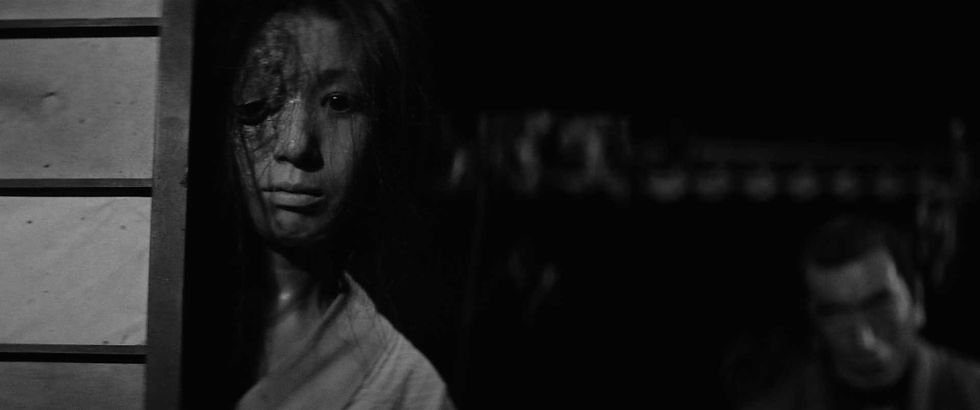
I have now seen a total of four movies based upon this particular legend of karmic retribution from beyond the grave. I don’t know that I’d rank The Tale of Oiwa’s Ghost as the “best” among them—that honor probably belongs to Keisuke Kinoshita’s 1949 two-parter, which reconfigures the story into a morally complex social drama akin to Sadao Yamanaka’s Humanity and Paper Balloons—but its sadistically unsentimental plot and relentlessly oppressive atmosphere certainly distinguish it as my personal favorite.


Comments