

Review: The Youth Killer
[The following review contains MAJOR SPOILERS; YOU HAVE BEEN WARNED!]
Kazuhiko Hasegawa’s The Youth Killer revolves around a brutal act of parricide. The catalyst for the crime is an argument regarding protagonist Jun Saiki’s “loose” girlfriend, but that isn’t really the cause—only the motive. Such conflicts are hardly uncommon, after all, and they rarely result in murder; what other environmental factors nurtured the irrational rage that ultimately culminated in violence? I believe his mother’s dying words suggest something approximating an answer: as she lies on the kitchen floor, freshly spilled blood intermingling with her recently slain husband’s, she gasps, “Finally, I won’t have to work hard anymore!”
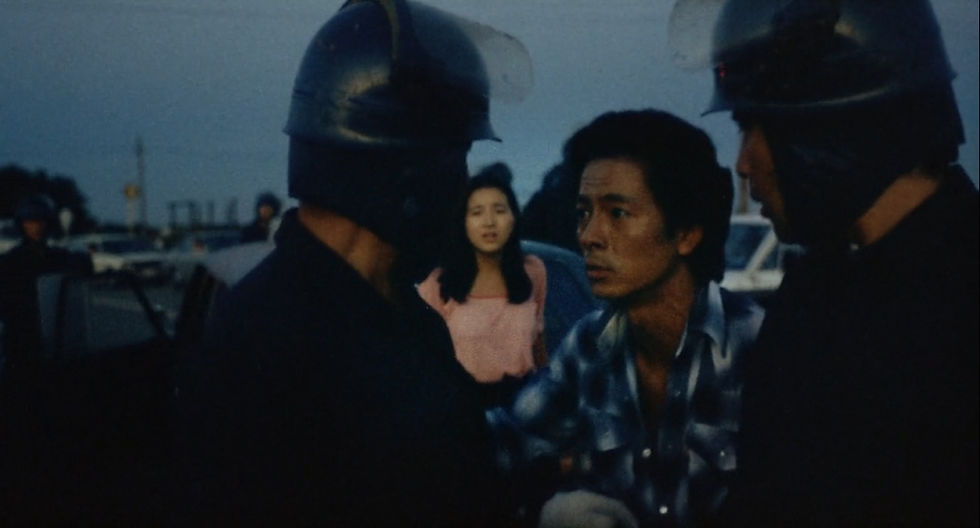
These characters inhabit a decaying society. Images of mass transit serve as a recurring visual motif: our disillusioned antihero manages a bar near an airport; the roar of jet engines and the chime of railroad crossing bells pervade the soundtrack. The commute between his workplace and his childhood home requires him to travel by both train and bus (it is worth noting that his parents have confiscated his car—another point of contention that contributes to their deaths). The miracles of scientific advancement and technological progress have enabled human beings to traverse miles of physical space in mere minutes; emotionally, however, people have collectively drifted apart, becoming isolated, alienated, distant and individualistic to a fault. Even the “traditional” family unit has eroded beyond recognition: Jun’s father—the quintessential small-time entrepreneur—seems to consider “love” a purely financial transaction, treating his son as a potential business partner and his wife as a low-wage employee. Just like the infrastructure of industry has thoroughly polluted the atmosphere, so too has this man’s soul been conquered and “colonized” by the corruptive forces of commerce and capitalism (I’m not pulling this interpretation out of my ass, by the way; the camera frequently lingers on smog-belching smokestacks, making the subtext rather explicit). Compassion and unconditional affection are utterly foreign to his mercenary worldview, in which relationships are investments and "spouses" and "progeny" are assets to be owned and exploited for personal gain.
Predictably, this fundamentally cruel setting offers little hope that justice will prevail. The authorities remain stubbornly indifferent to Jun’s repeated attempts to surrender, dismissing his confessions as pranks or delusions; they have more important matters to attend to—suppressing student protests, for example. The final shot depicts the reluctant fugitive—defeated, alone, burdened with guilt and shame—fleeing into an uncertain future in the back of a delivery truck. As the end credits roll, we follow him for a while, but he eventually vanishes from sight, swallowed by a black void pinpricked by twinkling city lights. Thus, the tragic story concludes with an ellipsis—an appropriately ambiguous punctuation to one of the most bleak, nihilistic, surreal, transgressive, darkly comic satires ever filmed.


Comments